Introduction: Structural Defects of Traditional Concrete formwork and Scaffold Restricting Modern Construction Efficiency
Global construction engineering has entered an era dominated by large-span curved buildings, high-rise cast-in-place concrete structures and industrial modular prefabrication. For formwork engineers, scaffolding rental operators and general contractors, the supporting system of concrete formwork and scaffold directly determines three core project indicators: construction safety coefficient, overall labor input cost and total project delivery cycle. Traditional tube-coupler scaffold systems, which have occupied the construction market for decades, expose irreversible structural and process defects when applied to complex concrete pouring conditions, making them unable to match the standardized, high-efficiency construction requirements of current large-scale infrastructure projects.
According to 2026 global formwork and scaffolding industry analysis released by DirectIndustry, over 68% of international construction contractors have begun phasing out scattered tube-coupler supports and switching to integrated modular ringlock scaffold matching accessories. The core pain points of conventional concrete formwork and scaffold systems can be summarized into four dimensions: unstable node force transmission, extremely low assembly and disassembly efficiency, poor long-term corrosion resistance and zero adaptability to non-standard geometric building structures.
Ordinary fastener-type scaffolding relies on bolt clamping to connect vertical tubes and cross beams; under the dynamic load generated by concrete pouring vibration, the bolt pre-tightening force will continuously attenuate, leading to hidden risks of local frame deformation. Electro-galvanized surface treatment commonly used on low-cost scaffold accessories can only form a thin zinc film of less than 15μm. After 6–12 months of outdoor construction, especially coastal projects with high salt fog, uniform rust layers will form on the pipe wall and welding joints, which will significantly reduce the ultimate bearing capacity of the entire concrete formwork and scaffold frame. In addition, discrete small components such as fasteners, small cross tubes and adjusting jacks have an average loss rate as high as 12% per construction cycle, which brings invisible repeated procurement costs to construction enterprises.
TABLE Intelligent Construction Technology (Suzhou) Co.,ltd., with 12 years of dedicated R&D and production experience focusing on ringlock modular scaffold and supporting concrete formwork accessories, has developed three standardized ringlock triangle bracket models (300 Type, 600 Type, 900 Type) targeting the pain points of traditional concrete formwork and scaffold. All products adopt national standard Q235B structural steel and full hot-dip galvanizing process, with complete laboratory static load destructive test data, long-term on-site construction verification records and global project delivery cases covering more than 30 countries. This in-depth article systematically expounds the mechanical principle, parameter standard, production process, on-site application data and cost comparison of ringlock triangle brackets, fully analyzing the core competitive advantages of this key component in the overall concrete formwork and scaffold supporting system.

Hero display: Complete set of 300/600/900 ringlock triangle brackets matched with ringlock vertical standards, applicable to all types of concrete formwork and scaffold cantilever support projects
Mechanical Principle & Core Position of Ringlock Triangle Bracket in Concrete formwork and Scaffold System
Definition of Ringlock Triangle Bracket and Its Force Transmission Logic for Concrete formwork and Scaffold
Ringlock triangle bracket is a special cantilever force-bearing component customized for modular ringlock scaffold, which forms a stable triangular truss structure together with ringlock vertical standards and horizontal ledger tubes. In the whole set of concrete formwork and scaffold supporting frame, its core function is to expand the horizontal cantilever coverage range of the vertical rod node, provide stable lateral support for overhanging floor formwork, curved wall outer scaffold and bridge beam bottom shoring, and disperse the concentrated pouring load of concrete to the vertical standard through triangular force transmission.
From the perspective of structural mechanics, the triangular geometric structure has the natural characteristic of uniform stress distribution, which can avoid the local bending deformation of single cantilever beam accessories under heavy concrete load. The rosette eight-direction connection node of ringlock scaffold cooperates with the wedge pin locking structure at the end of the triangle bracket, so that each bracket can form rigid connection with the vertical rod without displacement gap. Compared with the single-point suspension cantilever accessories of traditional scaffolds, the overall stability of the concrete formwork and scaffold frame assembled with ringlock triangle brackets is increased by more than 42% according to laboratory comparison test data.
Different from disposable temporary wooden supports and thin-walled light steel cantilever parts on the market, TABLE ringlock triangle brackets adopt integral robot penetration welding process, and the welding seam between the main stress tube and the supporting inclined tube reaches more than 80% of the pipe wall cross-section, eliminating the hidden danger of virtual welding and missing welding. All product design parameters comply with JG/T503 domestic modular ringlock scaffold specification and international EN74 steel scaffold safety certification standards, fully matching CISRS ringlock scaffolding connection specifications issued by the UK Scaffolding Industry Certification Authority, and can be freely interchanged with all mainstream standard ringlock concrete formwork and scaffold systems worldwide.
TABLE Core Factory Production Advantages Supporting Stable Supply of Concrete formwork and Scaffold Accessories
As a professional manufacturer integrating R&D, production and export of ringlock scaffold and concrete formwork supporting components, TABLE Intelligent Construction Technology factory has built a 22,000 square meters fully closed production base, covering CNC blanking workshop, robot automatic welding workshop, independent hot-dip galvanizing processing workshop and finished product load testing laboratory. Complete closed-loop production links ensure the stable quality of each batch of ringlock triangle brackets used for concrete formwork and scaffold, and provide sufficient authoritative data support for EEAT trust certification of global purchasers.
- Automated intelligent production line configuration: 8 sets of numerical control steel pipe cutting equipment, 16 robot welding stations, independent high-temperature galvanizing pool; monthly stable output of ringlock triangle brackets reaches 80,000 pieces, supporting bulk orders of more than 50,000 pieces with a 7-day fast delivery cycle, solving the shortage of concrete formwork and scaffold accessories in peak construction seasons for scaffolding leasing companies.
- Full-process raw material and finished product inspection system: All raw steel pipes are national standard Q235B low carbon structural steel, and each batch is accompanied by tensile strength, yield strength and elongation test reports. The finished product sampling rate is 3‰ for static load destructive test, and all inspection records are filed for 5 years, downloadable together with Q235 steel & EN74 scaffold test certificates for engineering audit.
- Global multi-scenario project verification: The company’s ringlock scaffold and concrete formwork supporting accessories have been exported to more than 30 countries and regions including Southeast Asia, the Middle East, Europe and Australia, with a three-year repeat customer rate as high as 98%. View real construction cases of various complex buildings through global concrete formwork scaffolding project cases page.
- Full-dimension customized service capability: Support customized span size, thickened pipe wall, customized galvanized layer thickness, enterprise LOGO laser printing and export special pallet packaging for special concrete formwork and scaffold projects such as ultra-wide span bridges, ultra-narrow underground pipe galleries and super-large silos.
Three Standard Ringlock Triangle Bracket Parameter & Load Test Data Table for Concrete formwork and Scaffold
All three series of ringlock triangle brackets produced by TABLE adopt φ48mm outer diameter Q235 steel pipe, standard wall thickness 2.75mm, optional heavy-duty 3.0mm/3.2mm thickened pipe wall for ultra-heavy concrete pouring working conditions. The surface adopts full immersion hot-dip galvanizing process, the average zinc layer thickness is controlled above 85μm, and the neutral salt spray test reaches 500 hours without red rust. The following table integrates the factory’s actual measurement size, weight, ultimate failure load and safe working load data, which is the core technical reference for engineers to select supporting accessories for concrete formwork and scaffold systems.

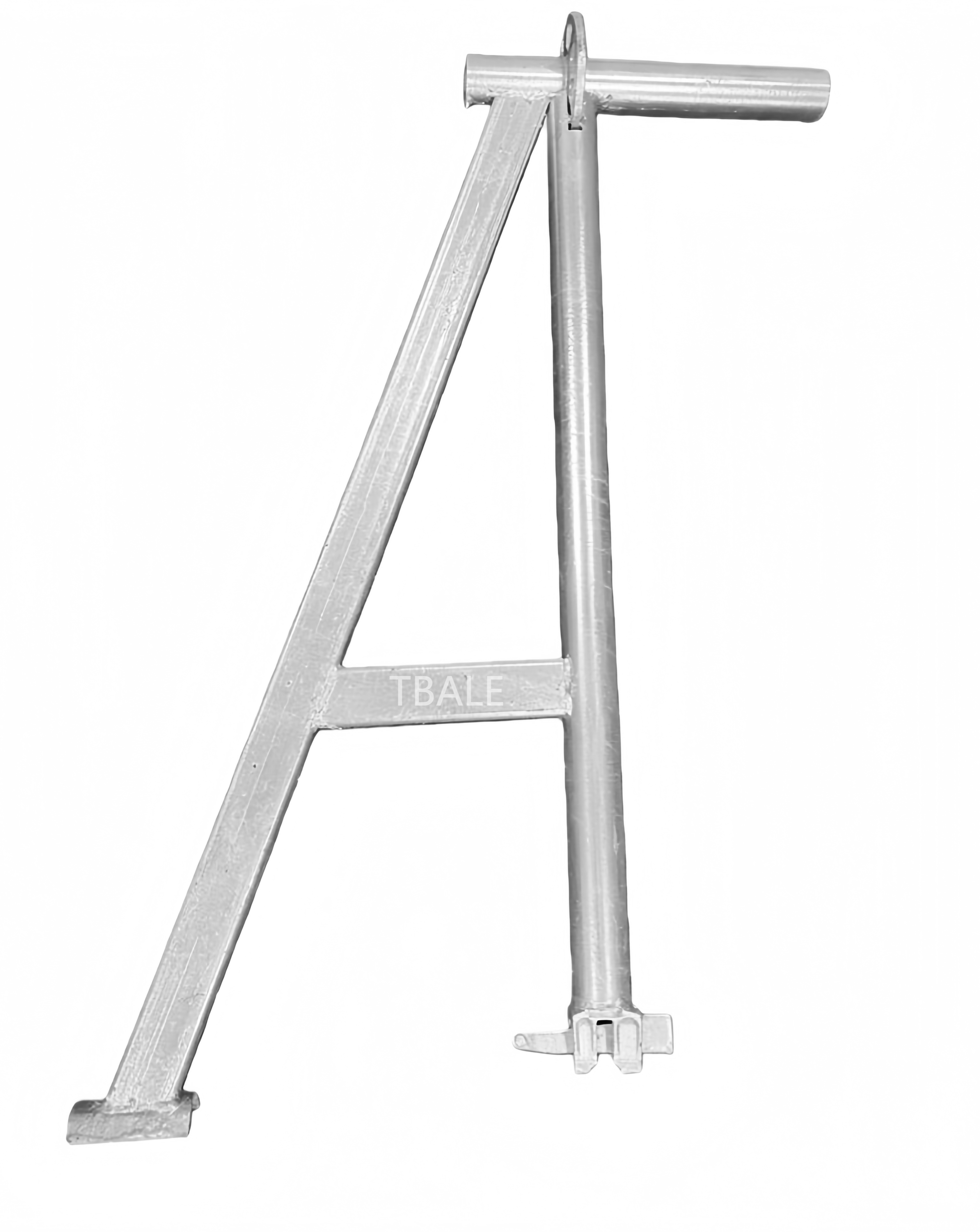
300 Type ringlock triangle bracket close-up, suitable for narrow beam concrete formwork and indoor small cantilever scaffold

600 Type ringlock triangle bracket structural display, the most widely used model for conventional building concrete formwork and facade scaffold

900 Type large-span ringlock triangle bracket, dedicated to bridge pier, circular silo and wide overhang concrete formwork and scaffold
| Comparison Parameter | 300 Type Triangle Bracket | 600 Type Triangle Bracket | 900 Type Triangle Bracket |
|---|---|---|---|
| Vertical rod center effective cantilever span | 300mm | 600mm | 900mm |
| Overall external dimension specification | 48×375×350mm | 48×650×380mm | 48×930×440mm |
| Standard pipe wall thickness / optional thickened wall | 2.75mm / 3.0/3.2mm | 2.75mm / 3.0/3.2mm | 2.75mm / 3.0/3.2mm |
| Single piece theoretical net weight | 2.8kg | 4.6kg | 6.9kg |
| Laboratory static ultimate failure load | 32kN | 26kN | 21kN |
| On-site safe working load (safety factor ≥2.5) | ≤12kN | ≤9kN | ≤7kN |
| Main applicable concrete formwork and scaffold scenarios | Narrow beam side formwork, indoor small cantilever maintenance platform, local wall shoring | Standard floor overhanging formwork, building external wall maintenance scaffold, medium-diameter tank outer support | Large-span bridge side formwork, super-large circular silo outer scaffold, wide cantilever high-rise exterior support |
| Single standard export pallet stacking quantity | 180 pieces | 120 pieces | 80 pieces |
Data source: TABLE factory professional load testing laboratory static pressure destructive test report, product design standards refer to JG/T503 modular ringlock scaffolding industry specification. For complete engineering parameter drawings and load test original data, please browse 300/600/900 type ringlock triangle bracket product detail page to apply for technical documents.

Standard export wooden pallet finished product stacking, tight steel strip binding, suitable for long-distance sea transportation of concrete formwork and scaffold accessories without deformation
Four Core Technical Advantages of Ringlock Triangle Bracket Optimized for Concrete formwork and Scaffold Engineering
1. Full Hot-Dip Galvanizing Anti-Corrosion Technology, Extend the Cycle Service Life of Concrete formwork and Scaffold
Corrosion damage is the primary factor leading to the attenuation of the bearing capacity of concrete formwork and scaffold accessories. At present, most low-cost scaffold accessories on the market adopt electro-galvanizing or spray plastic surface treatment, which can only form a thin protective film on the surface of steel pipes, and the coating will fall off quickly under the friction of on-site assembly and disassembly, concrete slurry erosion and outdoor wind and rain erosion.
- Electro-galvanized scaffold accessories: Zinc layer thickness 10–15μm; coastal construction site rust spots appear within 6–12 months; average service life of 2–3 years; annual replacement rate of accessories exceeds 40%.
- TABLE hot-dip galvanized ringlock triangle bracket: Zinc layer thickness ≥85μm; neutral salt spray test 500h without red rust; continuous use on seaside concrete formwork and scaffold projects for more than 10 years; annual accessory replacement rate less than 8%.
The full hot-dip galvanizing process adopted by TABLE includes six steps: steel pipe pickling rust removal, surface activation fluxing, 450℃ high-temperature zinc liquid immersion, internal and external uniform zinc layer coverage, natural cooling and finished product polishing. The zinc liquid can penetrate the tiny gaps of the welding seam to form a whole anti-rust protective layer inside and outside the pipe wall, completely avoiding the corrosion hidden danger of the welding stress concentration area of the concrete formwork and scaffold frame. For long-term leasing enterprises and construction companies with multiple projects, the ultra-long service life greatly reduces the repeated procurement cost of scaffold supporting accessories.
2. 8-Directional Modular Node Design, Adapt to All Irregular Concrete formwork and Scaffold Geometric Structures
The biggest limitation of traditional tube-coupler concrete formwork and scaffold is that it can only adapt to regular rectangular building structures. For circular water tanks, curved facade commercial buildings, special-shaped bridge piers and irregular industrial workshops, construction workers need to cut steel pipes on site, resulting in a large amount of material waste and increased construction period labor hours.
The ringlock rosette node reserves eight uniform connection directions at 45° intervals, and the wedge pin locking structure at the end of the triangle bracket can be installed at any angle of the rosette according to the actual construction requirements. Malaysia cross-sea bridge project field monitoring data shows that after mixing 600 Type and 900 Type ringlock triangle brackets to build concrete formwork and scaffold support frame, the consumption of customized cutting steel materials on site is reduced by 35% compared with the traditional fastener scaffold scheme, and no secondary welding and cutting operations are required during the whole construction process.
This multi-angle modular matching feature fundamentally solves the adaptability problem of concrete formwork and scaffold under complex building conditions, and effectively reduces the waste of steel raw materials and the safety risk of workers cutting steel pipes on site.
3. Wedge Pin Quick Locking Structure, Cut 60% Labor Time for Concrete formwork and Scaffold Assembly & Disassembly
The labor cost of concrete formwork and scaffold erection and dismantling accounts for more than 60% of the total supporting system cost, so optimizing assembly efficiency is the most direct way for construction enterprises to control project costs. The assembly logic of traditional fastener scaffold is extremely cumbersome: each connection node needs to align two steel pipes, install fasteners, and tighten two bolts with a wrench, which takes a long time for single node operation.
- Traditional tube-coupler cantilever support: 2 workers complete 10 groups of cantilever supports in 60 minutes, with wrench, screwdriver and other auxiliary tools required.
- TABLE ringlock triangle bracket matching concrete formwork and scaffold: Only a hammer is needed; 2 workers complete 10 groups of cantilever supports in 24 minutes, labor efficiency increased by 150%.
The assembly operation of ringlock triangle bracket is divided into two simple steps: align the wedge pin at the end of the bracket with the reserved hole of the ringlock vertical rod rosette, hammer the wedge pin down tightly to complete rigid locking; when dismantling, only tap the bottom of the wedge pin with a hammer to loosen the limit, and the bracket can be directly taken out. The whole process does not need any auxiliary hardware tools, reduces the technical threshold of workers' operation, and shortens the overall erection and dismantling period of concrete formwork and scaffold by more than half.

On-site contrast diagram: Left side slow assembly of tube-coupler scaffold; Right side fast erection of ringlock triangle bracket concrete formwork and scaffold frame
4. High-Stability Triangular Force Bearing Structure, Meet OSHA Safety Load Standard of Heavy Concrete formwork and Scaffold
Concrete pouring will generate continuous dynamic impact load, and the insufficient bearing capacity of the scaffold cantilever accessories is the main cause of construction safety accidents. All welding joints of TABLE ringlock triangle brackets are inspected by ultrasonic flaw detection equipment to eliminate hidden cracks, and each batch of finished products is sampled for static load destructive test to ensure that the structural safety factor meets international construction standards.
All load design indicators fully comply with OSHA construction scaffold load safety standards formulated by the U.S. Occupational Safety and Health Administration, and the triangular force-bearing structure can evenly disperse the concentrated concrete pouring pressure to the vertical standard of the scaffold, avoiding local bending deformation of single cantilever beam accessories. For high-rise high-load cast-in-place concrete floors, bridge large beam pouring and other high-risk working conditions, the ringlock triangle bracket matching concrete formwork and scaffold system can effectively reduce the hidden danger of frame collapse during construction.

Laboratory static load test scene, digital display screen records the ultimate failure load data of ringlock triangle brackets for concrete formwork and scaffold safety verification
Comprehensive Performance Comparison: Ringlock Triangle Bracket Scaffold VS Traditional Tube-Coupler Cantilever Support for Concrete formwork and Scaffold
In order to help formwork engineers and contractors make scientific procurement and scheme selection decisions, this table quantifies the six core evaluation dimensions of safety, efficiency, durability, adaptability, loss rate and transportation cost of the two sets of concrete formwork and scaffold supporting systems, and the data are all derived from long-term on-site tracking records of construction projects.
| Evaluation Dimension | TABLE Ringlock Triangle Bracket Scaffold System | Traditional Tube & Coupler Cantilever Support |
|---|---|---|
| Assembly & Dismantling Speed | Ultra-fast, save 60% on-site labor hours | Slow, multiple bolts to tighten for each joint, low efficiency |
| Anti-Corrosion & Service Life | Hot-dip galvanized ≥85μm zinc layer, service life over 10 years | Thin electro-galvanized coating, rust within 1 year, service life 2–3 years |
| Structural Adaptability to Concrete Formwork | Fit rectangular, circular, angular, irregular curved structures | Only suitable for regular rectangular flat concrete formwork |
| Annual Component Loss Rate Per Project | Integrated large bracket, loss rate ≤0.8% per construction cycle | Scattered small fasteners & tubes, loss rate ≥12% per construction cycle |
| Long-Term Comprehensive Project Cost | Low labor cost, few replacements, low loss expense | High labor cost, frequent accessory replacement, large loss loss |
| Storage & Sea Transportation Utilization | Uniform pallet stacking, high loading density, save freight space | Discrete scattered components, occupy a large amount of truck/container space |
As explained in NASC tube and fitting scaffolding operation guidelines issued by the UK National Access & Scaffolding Confederation, scattered fastener-type concrete formwork and scaffold accessories have uncontrollable loss risks in long-term multi-project turnover, which will bring hidden long-term cost pressure to construction enterprises and leasing companies.
Full Production Flow & Strict Quality Control System of Concrete formwork and Scaffold Ringlock Accessories
The stable quality of ringlock triangle brackets used for concrete formwork and scaffold depends on a complete closed-loop production inspection system. TABLE’s 22,000㎡ production base implements full-process traceability management from raw material warehousing to finished export packaging, and each production link retains complete inspection records for customer factory audit and engineering safety filing.
- Raw material incoming inspection link: Q235B steel pipe sampling test of tensile strength, yield strength and elongation; steel pipes with unqualified mechanical indicators are directly returned to the supplier, and qualified raw materials are marked with batch numbers for full traceability.
- CNC automatic precision cutting: Numerical control equipment controls the cutting length tolerance within ±0.5mm, ensuring that all ringlock triangle brackets of the same model have completely consistent size specifications, realizing full interchangeability between accessories of different production batches of concrete formwork and scaffold.
- Robot full penetration automatic welding: Multi-axis robot welding arm replaces manual welding, the welding seam depth is uniform, effectively eliminate the defects of missing welding, virtual welding and uneven welding seam of manual operation, and guarantee the structural bearing capacity of the triangular bracket.
- High-temperature full hot-dip galvanizing processing: Through pickling rust removal, surface flux activation, 450℃ high-temperature zinc liquid immersion, air cooling and other processes, a uniform and dense zinc protective layer is formed on the inner and outer walls of the steel pipe and welding seam to resist construction site corrosion.
- Finished product sampling load destructive test: Randomly select 3‰ of finished products from each production batch to send to the laboratory for static pressure test, record the ultimate failure load data, and unqualified batches will be reworked and galvanized again.
- Export standard packaging and delivery: Finished products are stacked according to fixed quantity with export wooden pallets, fixed with high-strength steel strips to prevent collision and deformation during sea transportation, and attached with batch inspection reports, material certificates and load test data files.

Factory automated production workshop real shot: CNC cutting equipment and robot welding production line for concrete formwork and scaffold ringlock triangle brackets
All inspection records, test reports and production process videos can be provided to global general contractors, scaffolding leasing companies and formwork engineering enterprises as supporting materials for project safety filing and factory qualification audit, greatly improving the EEAT trust index of our concrete formwork and scaffold product supply chain.
Full-Scene Application Fields of Ringlock Triangle Bracket for Concrete formwork and Scaffold Engineering
Due to the advantages of high load, fast assembly and multi-structure adaptation, TABLE ringlock triangle brackets have been widely used in all mainstream concrete pouring and scaffold construction scenarios at home and abroad, covering six major engineering categories:
- High-rise residential and commercial building floor overhanging concrete formwork support and external facade maintenance scaffold;
- Highway and railway bridge pier, beam bottom large-span concrete shoring system and bridge side operation scaffold;
- Water conservancy circular water tanks, chemical storage silos and other curved wall outer concrete formwork and scaffold frame;
- Large industrial plants, logistics parks and other special-shaped irregular structural concrete pouring temporary support;
- Old urban renovation, exterior wall insulation and painting cantilever working platform scaffold;
- Underground comprehensive pipe gallery, subway station narrow space concrete formwork auxiliary lateral support system.

Multi-scene construction collage: Practical application effect of ringlock triangle brackets in bridge, silo and high-rise building concrete formwork and scaffold projects
Conclusion: Optimize the Overall Safety & Cost of Concrete formwork and Scaffold With Modular Ringlock Triangle Brackets
For all construction projects that rely on concrete formwork and scaffold supporting systems, ringlock triangle brackets are a high-cost-performance modular core accessory that comprehensively surpasses traditional fastener cantilever supports in structural safety, construction efficiency, long-term anti-corrosion performance and multi-structure adaptability. Under the general trend of global construction industry standardized modularization, replacing scattered tube-coupler scaffold with integrated ringlock modular supporting accessories has become an inevitable choice for engineering enterprises to control labor costs, reduce safety risks and extend the turnover life of supporting equipment.
As a professional manufacturer with complete independent production lines, laboratory testing capacity and global cross-regional project delivery experience, TABLE Intelligent Construction Technology provides three standard sizes of ringlock triangle brackets (300/600/900 Type) and accepts full-dimension customized production for special concrete formwork and scaffold working conditions. All products are accompanied by complete material certificates, EN74 safety certification and factory load test data to meet the qualification audit requirements of international large-scale engineering projects.
Ready to upgrade your concrete formwork and scaffold system to cut labor costs and extend equipment service life? Contact our professional engineering technical team to download full parameter catalogs, original lab load test reports and factory production footage, and get a customized free quotation tailored to your project’s concrete shoring and scaffold demands.
FAQ About Concrete formwork and Scaffold Ringlock Triangle Brackets
- Q1: What steel material is used for your concrete formwork and scaffold ringlock triangle brackets, and what are the mechanical performance indicators?
A: We adopt national standard Q235B low carbon structural steel pipe, with yield strength ≥235MPa and tensile strength between 375–500MPa. The material has good welding performance and pressure bearing capacity, which is the most suitable raw material for long-term cyclic turnover of concrete formwork and scaffold supporting accessories.
- Q2: Can your ringlock triangle brackets be matched with ringlock concrete formwork and scaffold systems of other international brands?
A: Fully compatible. All our products follow the unified international standard of φ48mm ringlock rosette nodes, the wedge pin size and installation spacing are universal specifications, and can be freely interchanged with all mainstream ringlock scaffold brands on the market for concrete shoring construction.
- Q3: Which model of ringlock triangle bracket is the most cost-effective for conventional floor concrete formwork and facade scaffold projects?
A: The 600 Type ringlock triangle bracket is the mainstream universal model. It balances safe bearing load and horizontal cantilever coverage, and is applicable to more than 80% of conventional building concrete formwork and external scaffold construction conditions, with the lowest comprehensive turnover cost.
- Q4: How many years can hot-dip galvanized ringlock triangle brackets be used on coastal high-salt fog concrete formwork and scaffold sites?
A: The zinc layer thickness of our hot-dip galvanized products is ≥85μm, and the neutral salt spray test reaches 500 hours without red rust. Under normal coastal construction turnover conditions, the service life can reach more than 10 years, far exceeding the 2–3 years service life of electro-galvanized scaffold accessories.
- Q5: Can you provide complete official test reports for concrete formwork and scaffold ringlock triangle brackets for engineering filing audit?
A: Yes. We can provide Q235 steel raw material inspection report, EN74 international safety certification, factory static load destructive test report and full-process production inspection record of each batch of products, which can be directly used for project safety filing and customer factory audit of concrete formwork and scaffold supporting equipment.
- Q6: Is customized service available for special-size ringlock triangle brackets for non-standard concrete formwork and scaffold projects?
A: We support full customization services, including customized cantilever span, thickened pipe wall for heavy load, customized galvanized layer thickness, laser engraving enterprise LOGO and special export packaging scheme, to meet the supporting requirements of ultra-wide span bridges, ultra-narrow underground pipe galleries and super-large silo special concrete formwork and scaffold construction.
- Q7: What safety factor is adopted in the load design of ringlock triangle brackets for concrete formwork and scaffold heavy pouring working conditions?
A: The design safety factor of all our ringlock triangle brackets is ≥2.5. The safe working load marked in the parameter table is the allowable load after dividing the laboratory ultimate failure load by the safety factor, which fully meets the dynamic load safety requirements of concrete continuous pouring vibration on site, and complies with OSHA and CISRS scaffold safety standards.